
Why They Can’t See It
It’s all about the Story.

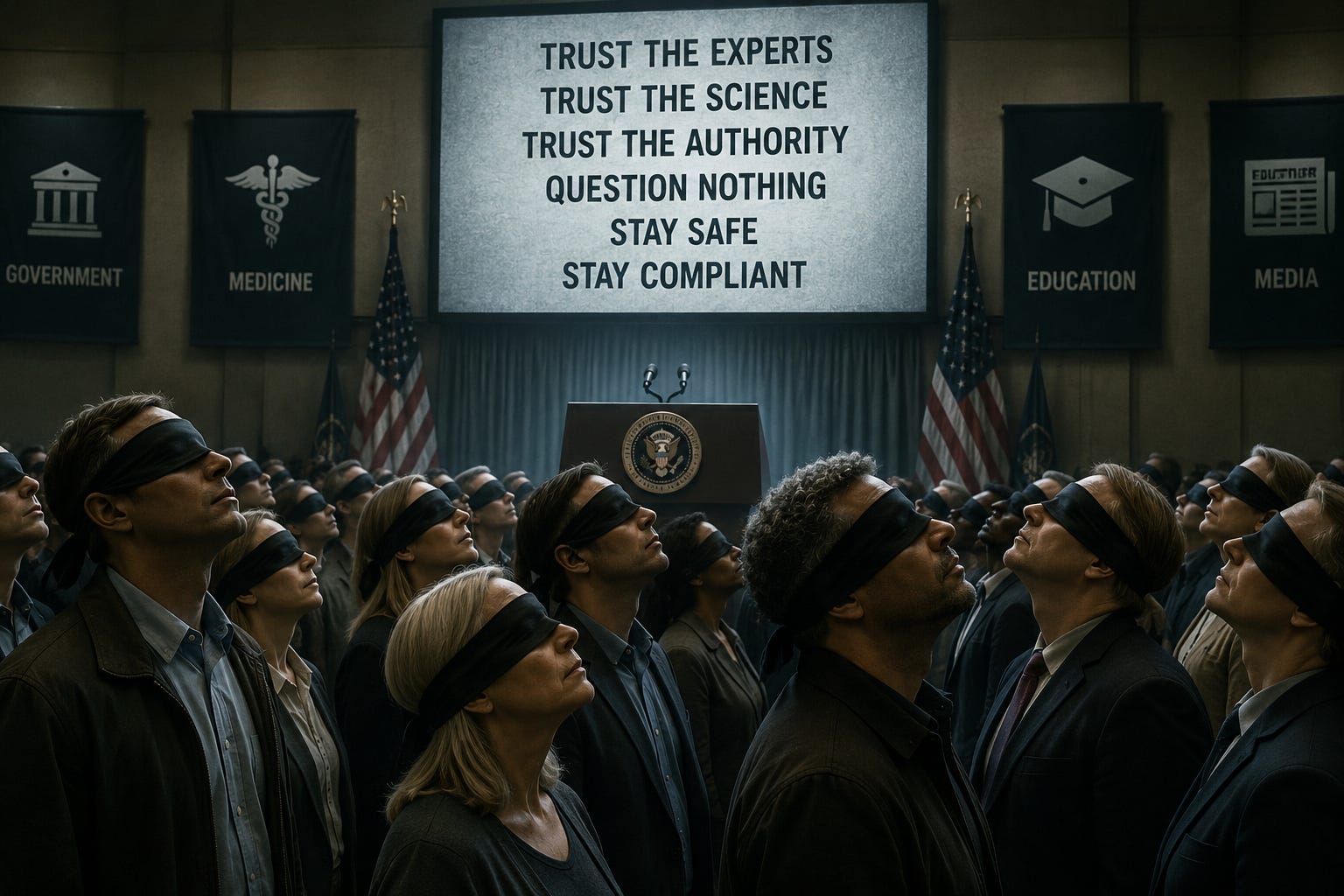
You show them the evidence. It is concrete, specific. Undeniable.
Or so you think.
And yet, they scoff, they ridicule, they refuse to see it.
Their blind belief in authority overrides all.
Why?
Well, by now, it should be obvious: the foundations of human belief are stories, not evidence.
Particularly comforting stories, such as “Institution Blah-de-Blah has my best interests at heart.”
People still refer to the CDC, or FDA, or WHO, or name your long-trusted letter agency, as if they not only still possess credibility as a trusted authority, but also as if they did not just experience the most massive case of caught-with-your-pants-down-and-also-murder-weapon-in-hand in recorded history.
And if it’s not your friendly neighborhood letter agency, it’s the scientific “peer-review” apparatus, or their professor, or their doctor, or just “experts” in general, as though there exists a certain class of people for whom we should just scoop out our brains with a soup ladle and hand them over, because… well, certificates.
Here’s the interesting part: the people granting their blind trust, often, are not idiots. In fact, often they’re the most intelligent people we know, which makes their blind trust both a head-scratcher and a heartbreak.
But a bad story supersedes anything in the realm of evidence.
Why?
1. Stories determine what we’re capable of seeing
It’s not that people are too unintelligent to recognize evidence. Rather, they interpret evidence according to the story they’ve come to believe.
Thomas Kuhn wrote about this in The Structure of Scientific Revolutions. Scientists, he pointed out, do not operate with a blank slate, confronting evidence and modifying their theories accordingly—far from it. They operate under a paradigm that dictates what “evidence” even means. They will call anything which confirms the paradigm “evidence”, and anything which challenges the paradigm as “anomaly”.
He pointed out that scientific theories are never challenged from within the paradigm. They are challenged from outside, when a competing paradigm can no longer be suppressed or ignored, and accordingly, there is a revolution.
Scientists are, after all, only human, and this is what we humans do: we make sense out of the chaos of reality by organizing it into stories.
So, let’s say your story is something like: “powerful institutions are fundamentally benevolent and exist to keep me and my family safe and serve our interests”.
Well, first off, you’re unlikely to even see any institutional wrongdoing. Your story tells you to not even bother looking.
Second, if someone does present evidence of wrongdoing, you won’t see it as “evidence”, you’ll see it as “anomaly”. You’ll explain it away as incompetence, or coincidence, or an isolated instance of corruption, easily mended with a firing and a hiring.
Third, you’ll treat the person who brought the evidence to your attention as if they were mentally unfit for polite society. You’ll call them crazy, you’ll call them “conspiracy theorists”, you’ll accuse them of spreading “misinformation.”
If, on the other hand, your story allows that institutions can be (and often are) systematically self-serving, fundamentally corrupt, based on a foundation of untruths, and misguided or even malicious in their aims… you will regard the exact same evidence very differently.
The evidence hasn’t changed.
The story has.
The faithful truster of institutions is not suffering from lack of intelligence—they’re operating under a paradigm which will not let them see the wrongdoing.
(Which works out super-conveniently for the wrongdoer.)
2. Even for the perceptive, stories provide blind spots
In the past, we’ve talked about the “aware” versus “narrative believers”.
I don’t think this cuts deep enough.
Some folks, for example, are highly critical, perspicaciously so, on one topic, yet seem to mindlessly toe the narrative line on another.
Maybe you’ve run across this: somebody you read or know brings an extraordinary level of critical scrutiny to something like the pharmaceutical industry. They rip it to shreds with scathing insight after scathing insight, proving it to be one of the most fraudulent and corrupt institutions to ever slither out of the slime.
Well and good.
But that same writer or person also has blind faith in a “hero” politician when they take office, or are incapable of seeing that politician’s severe faults, or the fact that their placement in office is a manipulation designed to relax the scrutiny of half the population now that there is a “good guy” fighting on their behalf.
WTF happened to their perspicacity?
Well, they believe a story that goes something like: “institutions deserve our scrutiny right up until the moment they are rescued by good guys. Then, mercifully, we can turn our scrutiny off.”
So, if anyone with sinister motives is paying attention: supply a false hero, turn half the population’s brains off, and let your savior figure run cover, and keep right on committing crimes against humanity. Got it?
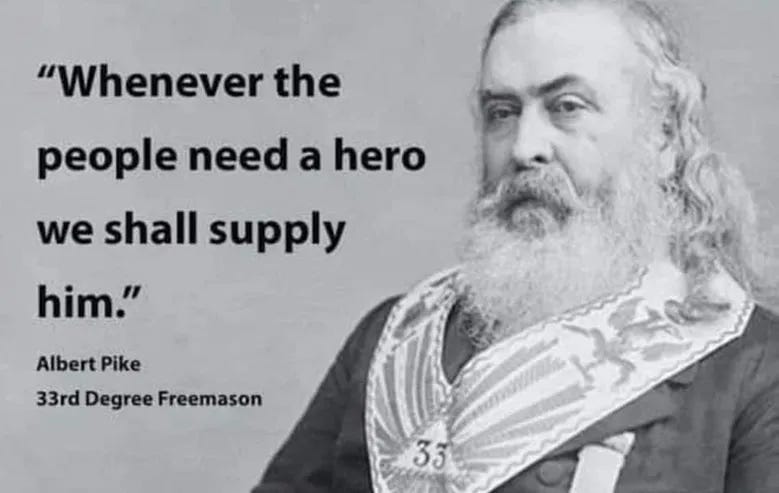
If, on the other hand, a person operates under the story that “powerful institutions always deserve our scrutiny, including, and maybe even especially, when we are supplied with ready-made heroes meant to pacify us”…
...well, we’re going to regard that supposed “savior” very differently, aren’t we?
The dividing line here isn’t “aware” versus “narrative believer”.
The two things, unfortunately, can coexist in the same human skull case.
Instead, each of us needs to ask: what stories are operating on me which might blind me to a portion of the truth and cause me to turn off my otherwise sharp faculties?
In other words: Do I have a blind spot?
3. Stories usually have villains, but evil rarely shows up wearing a villain’s costume.
People imagine evil as sprouting horns and belching brimstone.
But what if evil looks like ordinary people doing ordinary things? Maybe it even looks like your neighbor, or your charming co-worker, or a family member. Maybe even like the person in the mirror…
C.S. Lewis wrote that the greatest evils are “conceived and ordered... in clean, carpeted, warmed and well-lighted offices, by quiet men with white collars and cut fingernails and smooth-shaven cheeks who do not need to raise their voices.”
Evil doesn’t need to wear jackboots and march in lockstep and roll tanks down the central avenue of your city. It’s more likely to show up in a well-tailored business suit (or a clean white lab coat, for that matter) and conduct its villainy with a handshake at a sunny cafe whilst sipping on a kombucha and nibbling on a sprouted-grain bun.
Those must be good guys, right? After all, bad guys have eye-patches and maniacal cackles and pale skin from living in subterranean bunkers. Right?

As if evil can’t figure this most basic of deceptions. As if political campaigns weren’t built precisely on this chicanery. The word charm means to fool by putting under a spell, i.e., it requires fools to work.
Let’s consider too, the villains that don’t even realize they’re villains.
They too, are under the grips of Story, one which tells them they are blessed with mystical special sauce and therefore they need to carry out their plans for the “good of humanity.” I wonder how many of history’s atrocities have been carried out with that lofty phrase ringing in the ears of the wrongdoers? If it were a number approaching 100% I wouldn’t be surprised.
And then there’s the work-a-day wrongdoers, caught in the grips of one or more of the following:
irresistible financial incentives and career advancement opportunities;
bureaucracy so entrenched it’s impossible to challenge, at least from within;
cowardice (keeping quiet when speaking up would cost you);
the diffusion of responsibility into such tiny modules that no one realizes that they are contributing to a larger evil;
a desire to “just follow orders”;
an organizing story which convinces them they are super-swell citizens and making the world a better place;

Ordinary folks behaving ordinarily, in other words.
Hannah Arendt went to great lengths portraying the “banality of evil”, calling it “terribly and terrifyingly normal”. Even if there were a bunker-dwelling Bond villain behind the installation of a harmful system, the maintenance of that system—the day-to-day, turn the lights on and keep the factory running operations—are maintained by average, ordinary, well-meaning folk just trying to do their job, avoid too much attention, and take home a paycheck.
It makes it so that the participants in evil institutions don’t realize it, or that they believe they are doing the right thing.
Again, they’re suffering under a bad story—one that convinces them they’re the good guys, and the bad guys are the ones who question the institution. How dare they?
But, as we know all too well, harmful, even brutal, outcomes emerge from systems whose participants see themselves as simply doing their jobs or being “good citizens”.
4. The abandonment of the story means facing too overwhelming a horror
This is true for many people we know—even the intelligent ones.
The official narrative story is not just a bland description of truth as they see it — it’s psychological shelter.
Trust in benevolent institutions is not a dispassionate intellectual position—it is emotional survival.
If that story collapses — if the government, the medical system, the media, the scientific authorities, the legal system, the public health establishment are not fundamentally acting in good faith — the implications are enormous:
maybe nobody is coming to save them;
maybe the people with power do not deserve their trust;
maybe the systems they were taught to believe in are fraudulent or malicious;
maybe they are far more responsible for their own safety, judgment, education, health, and discernment than they want to be.
Challenging this story would not just be “changing their mind.”
It would be a complete loss of psychic shelter.
Their mind resists that loss—not because they’re stupid—but because accepting it would mean stepping into a world that feels chaotic, unmanaged, unsafe, incoherent, and impossibly burdensome.
And so, the story prevails.
In short, if two people, even intelligent people, believe different stories, they will perceive two different realities.
Evidence, at that point, is a null concept.
Does this mean the situation is hopeless?
Thomas Kuhn talked about incommensurability. The adherents to two different paradigms cannot reach each other or find any common ground… they’re not only talking in different languages, they’re not even using the same concepts. Kuhn was famously droll on this matter, remarking: “a new scientific truth does not triumph by convincing its opponents and making them see the light, but rather because its opponents eventually die, and a new generation grows up that is familiar with it.”
I think we can do better than generational die-off, however.
Narrative change does happen, even if it takes years, or even decades. You’ll profess a challenge to the prevailing story—the response is horror, shock, and brutal reactivity—and then a few years later everyone and their pet poodle is spouting the same thing. Oh, and by the way, it’s the incontrovertible truth and they knew it from the beginning of time.
So it goes.
If we were hopelessly locked into our narratives, the world as we know it would not exist, and we’d still be cowering in caves and treetops.
The human mind is a little like an immense, immovable boulder. It doesn’t want to budge. It likes where it is. If you’re using evidence to move it, you might as well be using a toothpick for a lever.
But minds do budge, eventually.
The key is knowing where to push.
Or, you know… getting a bigger stick.😏
YOU make Think for Yourself possible with your subscriptions. If you believe in the work being done here and want to show your support, consider becoming a free or paid subscriber!
Or perhaps you know someone that would appreciate a gift sub:
Or, if a sub is too much commitment, consider a one-time donation:


Or donate some crypto:
Bitcoin Address:
3BRCXdECrTq1WHHz8jrztGCNwzKQyWsEUA
Follow JET on the Socials:
Further Reading:


The jab enthusiast I know - and I think this is quite common - believes the jab saved trillions of lives. So all the harm is moot. Since that number, or whatever number is pulled out the nether-lands, is impossible to prove or disprove, the beat, and the jab, goes on. Well played!
This is brilliant, thank you. As a psychiatrist, dealing with your fourth point--"the abandonment of the story means facing too overwhelming a horror"--comprises the bulk of my work. People will go to remarkable lengths to cling to their preferred stories, however incommensurate with reality they may be. They will suffer dreadfully rather than go through the legitimate suffering of giving up their old stories. Often these false stories involve seeing themselves as passive victims and others as oppressors--rather than admitting to their own bad decisions and lack of effort.